
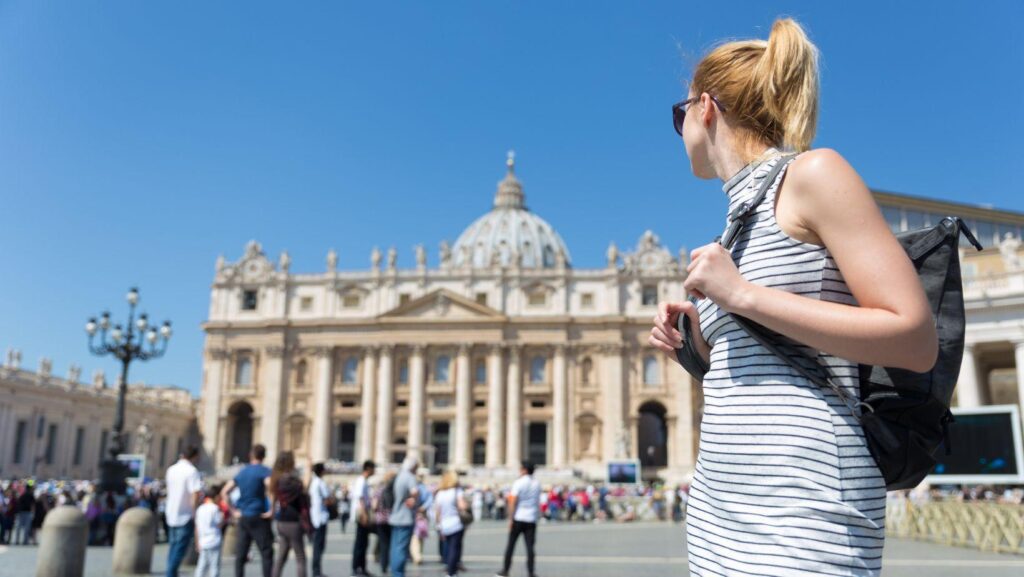
The most visited Catholic pilgrimage destinations are Rome and Vatican City, the Holy Land, Lourdes, Fatima, Santiago de Compostela, Medjugorje, Assisi, Knock, Guadalupe, and Czestochowa. Each one is anchored to something real: a martyr’s tomb, an apparition approved by the Church, or a shrine that has drawn prayer for centuries.
What Separates a Pilgrimage from an Ordinary Trip?
A pilgrimage is travel ordered toward prayer. The itinerary is built around Mass, confession, adoration, and time at the site itself, not around sightseeing that happens to include a church. That difference shapes everything: the pace is slower, the group prays together, and a priest usually travels with you.
It also changes how you should plan. Entry to papal audiences, celebrating Mass at a side altar in a basilica, and reserved times at major shrines are not things most independent travelers can arrange. Well-organized Catholic pilgrimage tours handle those permissions in advance, which is why most pilgrimage travel is done this way.
Which Destinations Should You Consider First?
1. Rome and Vatican City
The seat of the Church and the burial place of Saints Peter and Paul. Expect the four major basilicas, the Scavi tour beneath St. Peter’s, the Holy Stairs, and a Wednesday papal audience. First-time pilgrims almost always start here.
2. The Holy Land
Israel and Palestine put the Gospel in front of you: Bethlehem, Nazareth, the Sea of Galilee, the Mount of Beatitudes, and the Via Dolorosa ending at the Church of the Holy Sepulchre. Many pilgrims renew baptismal promises in the Jordan River.
3. Lourdes, France
Our Lady appeared to St. Bernadette here in 1858. The baths, the candlelight rosary procession, and the torchlight Marian procession define the experience. Lourdes is also the most accessible major shrine for pilgrims with illness or limited mobility.
4. Fatima, Portugal
Three shepherd children received the 1917 apparitions in this quiet hillside town. The Chapel of the Apparitions, the tombs of Saints Francisco and Jacinta, and the nightly rosary in the vast square draw pilgrims year-round.
5. Santiago de Compostela, Spain
The traditional resting place of St. James the Greater and the end point of the Camino. You can walk the final 100 kilometers to earn the Compostela certificate or arrive directly for the Pilgrim’s Mass and the swinging botafumeiro.
6. Medjugorje, Bosnia and Herzegovina
Known for confession, Apparition Hill, and the climb up Cross Mountain. The Church has approved pilgrimages here while continuing to study the reported apparitions, and the town remains one of Europe’s busiest prayer destinations.
7. Assisi, Italy
The home of St. Francis and St. Clare. The Basilica of San Francesco, the Portiuncula inside Santa Maria degli Angeli, and the hermitage on Mount Subasio suit pilgrims drawn to poverty, simplicity, and creation.
8. Knock, Ireland
In 1879, fifteen villagers witnessed an apparition of Our Lady, St. Joseph, and St. John at the parish church gable. Knock pairs naturally with Ireland’s monastic sites, Croagh Patrick, and the Cliffs of Moher.
9. Our Lady of Guadalupe, Mexico City
The tilma of St. Juan Diego hangs above the altar in the Basilica of Guadalupe, the most visited Marian shrine on earth. Its proximity makes it a strong choice for North American parishes with limited travel time.
10. Czestochowa, Poland
The Black Madonna at Jasna Gora is the spiritual heart of Poland. Combine it with Krakow, the Divine Mercy Shrine in Lagiewniki, Wadowice, and Auschwitz for a deeply moving week.
How Do You Pick the Right One?
Match the destination to your intention. Grieving or seeking healing points toward Lourdes. Wanting to understand Scripture points toward the Holy Land. A parish with older travelers should favor shrine-based itineraries with short walking distances over the Camino. Season matters too: shoulder months bring lower fares and thinner crowds.
Frequently Asked Questions
How long does a Catholic pilgrimage usually last?
Most run 8 to 12 days. European shrine combinations often fit in a week, while the Holy Land typically needs 9 days or more.
Do I need to be physically fit?
For most shrines, no. You should be able to walk 2 to 3 miles a day on uneven ground. Lourdes and Fatima are the easiest options for anyone with mobility limits.
Is traveling with a group better than going alone?
A group gives you daily Mass, a chaplain, ground transport, and access that individuals rarely get. Solo travel offers flexibility but very little of that structure.
Ready to Choose Your Destination?
Pick the shrine that answers what you are actually carrying, then let someone experienced build the rest. For itineraries, departure dates, and help matching a destination to your parish or family, visit selectinternationaltours.com and start planning a journey your faith will remember.